
BIRD BASICS
Do you like to solve puzzles? There are so many birds to be found wherever you are that identification of a bird is like solving a mystery. The best tools you have to solve these puzzles are your brain and a decent pair of binoculars.
From the beginning: Animals are living things that must eat in order to get the energy they need to live. The different types of animals are sorted and classified into basic groupings. The species name is the fundamental group name for a type of living thing. Individuals that are of the same species are able to mate and produce offspring. Birds are animals that have developed special adaptations to find and use a variety of food sources.
Birds come in a wide variety of sizes, shapes, and colors and are spread throughout the world today. Over several hundred million years, some inherited traits were more useful than others, and made individuals with those traits more successful at getting food, living well, and producing offspring. The successful birds lived and passed the useful traits to their offspring. In this manner, bird species have been multiplying and have spread out across the world. The changes in these birds and their descendants as they moved into different habitats have resulted in the development of well over 10,000 bird species today.
Birds are very intelligent, have excellent eye sight, and many are very social. They primarily forage during the day. There are some birds that do not fly but all birds have feathers. Birds that do fly have a light-weight skeleton and their wings and feathers are designed especially for flight. Birds maintain their body temperatures so they can live in all land areas as long as there is something to eat. Laying eggs reduces the weight burden for flying. However, this means that they need to stay on their nests to keep their eggs warm. In many bird species, individuals mate for life and share parental duties.
In North America there are over 1,000 species. In your backyard, you may see several dozen species. During different seasons there are different birds but some may be seen in your yard all year long.
When trying to identify a bird, look for key traits. That is, if you can note the size, color of the bird and special markings, and the shapes of the bill, legs and feet, you are well on your way to identifying the bird. The location of the bird, for example, on the ground, in the tree, among flowers or flying over water will help you narrow down your choices. When observing birds also listen to their songs. Each bird species has unique songs, although a few species mimic the songs of other birds.
Size: Most birds are small and eat insects. This book identifies a small bird as one that has a body length smaller than 7 inches (fits into an adult hand), with wingspans up to 12 inches, and weigh less than an ounce (about the weight of a AA battery). We categorize a medium-sized bird as a bird with a body length from 7 inches to 13 inches (twice the length of a hand), with wingspans from 1 to 2.5 feet, weighing from 1 to 6 ounces (6 ounces = weight of a large apple). The last category in this book is for large birds, with a body length from 17 inches to over 4 feet and wingspans from 3 to 6 feet. Large birds in this book weigh from 1 to over 9 pounds. The smallest bird in this book is the Ruby-throated Hummingbird at about 0.11 ounces, about half the weight of a new wooden pencil! The Bald Eagle has the largest wingspan, over six feet. The Canada Goose has a longer body than the bald eagle, a shorter wingspan, but weighs a similar amount.
Color and markings: Note the color of the feathers of the bird, its plumage, but be aware that the males and females of a species often look different. Fortunately, a mated pair is often found together. Pay particular attention to the crown (the top of the head). The crown may have a different color and there may be stripes near the eyes or a different throat color. These are all valuable clues for identification.
Bills: The bill shape is a clue to what the bird eats. Insect eaters could have small and/or flat bills. A short and thick bill suggests a seed eater. Long and narrow bills belong to birds that probably eat fish. A strong, hooked bill indicates a bird of prey or carrion eater.
Legs and feet: Short legs indicate that the bird is more often flying or swimming. Strong talons suggest a bird that grabs its prey or carrion. Delicate toes may help wrap feet around a branch when perched in a tree. Wide and webbed feet help paddling in water.
Location: Different types of birds are seen near the beach or lakes than are seen in a meadow or woodland. Native shrubs, trees, and flowers will attract birds to your yard. Birds need water just like we do so providing water in your yard, for example with a bird bath is important.
Scientists use the classification groupings of genus and species names for each bird. The genus is a grouping that includes similar species. By using a scientific system it is easier and better to compare notes around the world about particular birds.
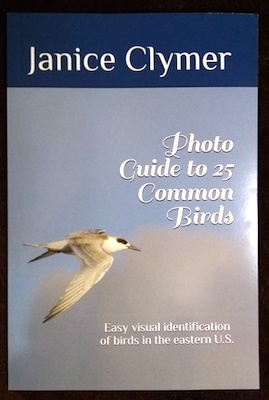
Photo Guide to 25 Common Birds
Purchase this book on Amazon.
Visit the RandomNaturePC ETSY site for home decor, mugs, bags and apparel featuring our nature photographs.
Your random nature pleasantly captured musings guide: Janice is a retired Biology Professor with interests in birding, gardening, and photography. She earned a Ph.D. in Biological Sciences at the University of California, Irvine. Her doctoral dissertation was an examination of plant/butterfly interactions and natural product chemistry.